Hotel Management System: Reservations, Front Desk, Cash and Analytics in One Place
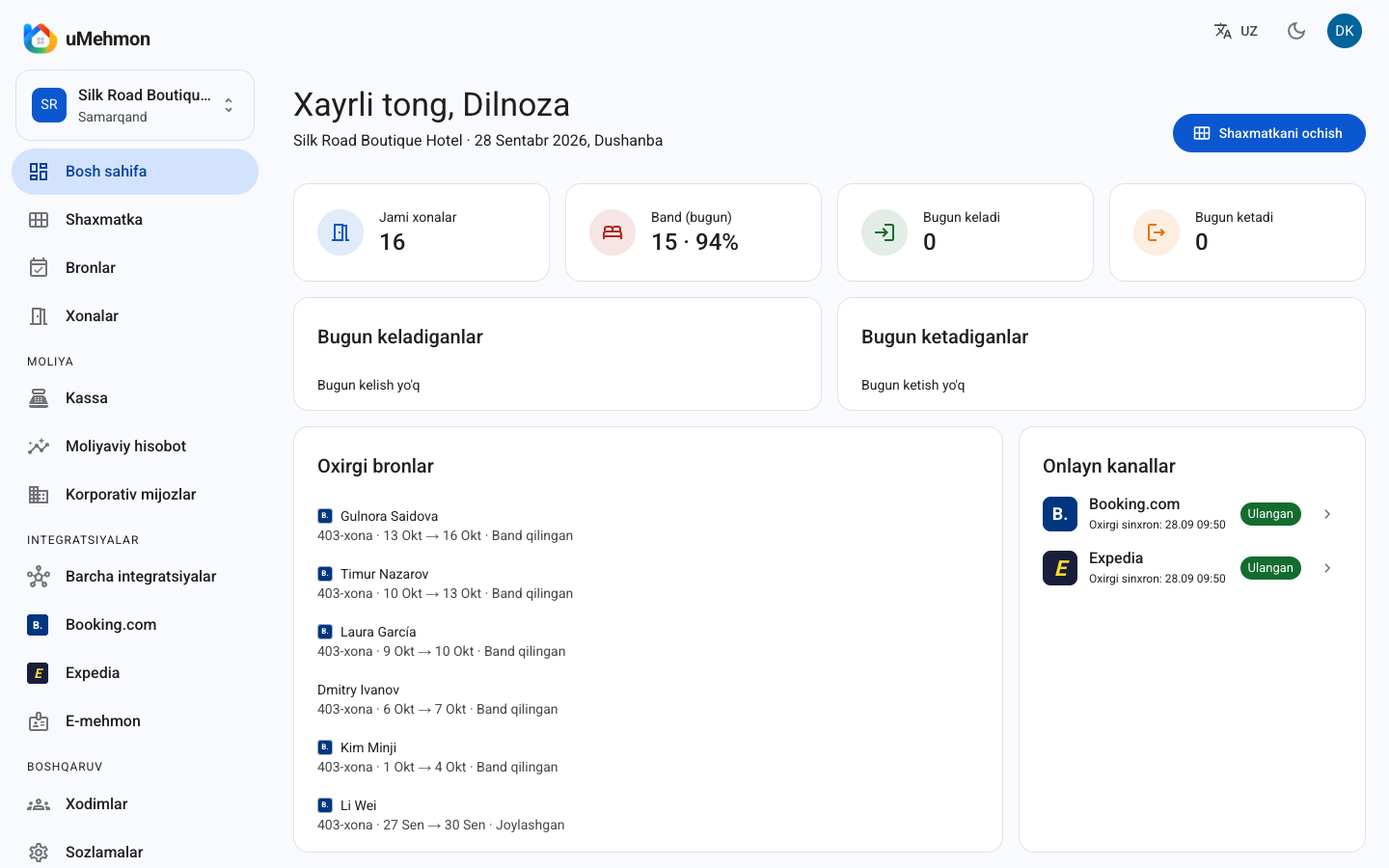
Short answer: a hotel management system is software that brings reservations, room status, guest registration, the cash desk and reporting into a single screen. uMehmon is a cloud hotel management system built for Uzbekistan and Central Asia: a live tape chart, automatic E-mehmon guest registration, a multi-currency cash desk, Booking.com and Expedia sync, and roughly 24 USALI-based financial KPIs. It runs in the browser with nothing to install, and you can start a 14-day free trial today.
What is a hotel management system and why do you need one?
Every hotel asks the same questions every day. Which rooms are free tonight? Who is arriving and who is leaving? Which room is still dirty? How much cash is in the drawer? Where did that Booking.com reservation land? With a paper logbook and spreadsheets, answering them means phoning colleagues, cross-checking tabs and recounting cash.
A hotel management system — more formally a property management system, or PMS — moves all of that into one central database. The front desk, managers, cashier and owner see the same data in real time. Create a booking and the room is blocked. Check a guest out and the room flips to "dirty". Take a payment and the cash balance updates instantly.
The point is fewer mistakes and decisions based on numbers rather than gut feeling. A double-sold room, a missing payment or a guest who never got registered with the authorities all cost money and reputation. A good hotel PMS warns you before those things happen.
Who is uMehmon built for?
uMehmon targets small and mid-size properties:
- City hotels and boutique hotels from 5 to 300 rooms
- Hostels that sell by the bed — see hostel management software
- Apart-hotels, serviced apartments and guest houses — see apart-hotel PMS
- Small groups running several properties under one account
Core modules of the uMehmon hotel management system
Everything below is live in the product today. All modules share one database, so bookings, payments and reports stay in sync.
Tape chart: every room on one screen
The tape chart (also called a room rack) is the heart of the system. Rooms run down the rows, dates run across the columns, and you can switch between 7, 14, 30 and 60-day views. Occupied nights are highlighted in red.
- Drag a booking to a different room or date
- Select empty cells to create a new booking on the spot
- An "unassigned bookings" row that catches reservations without a room and raises an overbooking warning
- Live updates, so several staff members can work at the same time without overwriting each other
- A daily summary: occupied, vacant, arrivals, departures and occupancy percentage
Reservations: nightly, hourly and group
Beyond standard nightly bookings, uMehmon supports hourly day-use stays. Any hourly booking longer than 8 hours is charged at the nightly rate. Each rate has a min–max range; front-desk staff can price within it, and anything outside the range needs a manager's approval.
The reservation module also covers:
- Walk-ins with instant check-in
- Group bookings — several rooms under one name, checked in, checked out or cancelled together
- Room moves with a recorded reason, stay extensions and paid late check-out
- No-shows, cancellation and reinstatement, and early departures that release the remaining nights
- Prepayments and corporate discounts
- Same-day resale of a room once the departing guest has left and housekeeping has cleaned it
Housekeeping: room status that drives availability
Each room is clean, dirty or inspected. Check-out sets the room to dirty automatically, and a dirty room cannot be assigned for today until it has been cleaned. Rooms under maintenance are taken out of inventory.
E-mehmon integration
In Uzbekistan every guest must be registered in the government E-mehmon system. uMehmon ties this to the reservation itself: the guest is registered automatically at check-in, and at check-out the system asks whether to deregister them too. Passport data can be pulled from the Ministry of Internal Affairs database, foreign guests have visa and border-crossing fields, failed submissions go into an automatic retry queue, registration numbers can be entered manually, and every event appears in the E-mehmon log.
This step is easy to underestimate. Without an integration, someone has to re-type every passport into a separate portal — exactly the kind of double entry a hotel management system should eliminate.
Cash desk and folio
The cash desk handles cash in UZS and foreign currency (USD, EUR, RUB), cards (Uzcard, Humo, Visa, Mastercard), POS terminals, bank transfers and online payments. Central Bank exchange rates update with a single click. Expenses are categorised, and cash collections and deposits are logged separately.
The key control rule: a transaction can never be deleted, only voided with a reason. Cash and card balances are visible in real time.
The folio is the guest's account — charges, payments and balance. Invoices print on your letterhead with logo, company details, tax ID, bank details, the amount in words and sequential numbering such as INV-2026-00001, or export to PDF.
Corporate clients
Each company profile stores a discount percentage and a billing rule: "company pays" or "guest pays". Accounts receivable per company are tracked separately.
Channel manager
The Pro and Business plans include a channel manager. Two-way iCal sync with Booking.com is live now, and the Connectivity API (B.XML) is available with a certified account. Expedia connects via iCal today, with API access to follow Expedia certification. Incoming bookings are placed into a free room automatically, show up in red on the tape chart, and trigger a notification on every screen. If no room is free, you get an overbooking warning. Read more on the Booking.com integration page.
Agoda, Airbnb, Trip.com, Hostelworld, Traveloka, Google Hotels and Tripadvisor are on the roadmap and not yet available.
Financial analytics
About 24 USALI-based KPIs: room revenue, GOP and GOP margin, occupancy, ADR, RevPAR, GOPPAR, ALOS, booking lead time, cancellation rate, direct, OTA and corporate share, average discount, collection rate and more. Every metric compares against the previous period, with daily charts and a revenue-source breakdown. See hotel analytics for details.
Team roles and audit trail
Five roles: Superadmin, Director, Manager, Finance (cashier) and Front Desk. Add staff with email and password, or send an invite link. The activity log records every action — who, when, and old versus new value. It cannot be edited or deleted and exports to CSV.
Comparison: logbook vs spreadsheet vs basic software vs uMehmon
| Criterion | Paper logbook | Excel / Google Sheets | Basic desktop software | uMehmon |
|---|---|---|---|---|
| All rooms on one screen | No | Partly, manual | Yes | Yes, 7–60 day tape chart |
| Several users at once | No | Conflict risk | Usually one PC | Yes, live updates |
| E-mehmon registration | No | No | Rarely | Automatic at check-in and check-out |
| Booking.com sync | No | No | Often no | Two-way iCal plus API |
| Cash control | Manual | Formulas, deletable | Varies | Void only, with reason |
| Audit trail | No | No | Rarely | Immutable activity log |
| Mobile access | No | Partly | No | Yes, in the browser |
| Reporting | Manual | Manual formulas | Basic | ~24 USALI KPIs |
Key hotel metrics: formulas and worked examples
Much of a hotel management system's value lies in calculating the numbers for you. The formulas below are standard across the industry; uMehmon derives them from bookings and cash-desk data automatically.
| Metric | Formula | What it tells you |
|---|---|---|
| Occupancy | Room-nights sold ÷ Room-nights available × 100% | How full the hotel is |
| ADR | Room revenue ÷ Room-nights sold | Average selling rate |
| RevPAR | Room revenue ÷ Room-nights available (or ADR × Occupancy) | Revenue per available room |
| ALOS | Room-nights ÷ Number of bookings | Average length of stay |
| GOP margin | GOP ÷ Total revenue × 100% | Operating efficiency |
| Cancellation rate | Cancelled bookings ÷ All bookings × 100% | Demand stability |
Example: a 20-room hotel sells 14 rooms for one night with room revenue of 7,000,000 UZS. Occupancy = 14 ÷ 20 = 70%. ADR = 7,000,000 ÷ 14 = 500,000 UZS. RevPAR = 7,000,000 ÷ 20 = 350,000 UZS.
Example: in one month there are 60 bookings totalling 180 room-nights. ALOS = 180 ÷ 60 = 3 nights. If 6 of those bookings were cancelled, the cancellation rate = 6 ÷ 60 = 10%.
You can do this in a spreadsheet, but every cancellation, extension or room move means updating it by hand. In a system the figures are always current. Go deeper with how to calculate RevPAR, what is ADR and what is hotel occupancy.
A day at the front desk with uMehmon
- Morning. The receptionist opens the tape chart; the daily summary shows arrivals, departures and occupancy.
- Overnight OTA bookings. Booking.com reservations are already sitting in free rooms; if one couldn't be placed, it waits in the unassigned row with a warning.
- Check-out. The folio is settled, the room turns dirty, and the system offers to deregister the guest from E-mehmon.
- Housekeeping. The room is marked clean or inspected and becomes available for today's arrivals.
- Check-in. Passport details are entered or pulled from the government database, and the guest is registered in E-mehmon automatically.
- Evening. The cashier reconciles cash, card and foreign-currency balances and logs the cash collection.
- The owner checks daily revenue, occupancy and RevPAR from a phone.
Questions and answers
Question: Can front-desk staff discount a rate on their own? Answer: Only within the configured rate range. Anything below the minimum needs manager approval, which keeps informal "friends and family" discounts under control.
Question: What happens if the internet goes down? Answer: uMehmon is cloud software, so it needs a connection. In practice properties keep mobile data as a backup, since the system runs on phones and tablets as well.
Question: Do I need to check in a 10-person group one by one? Answer: No. A group booking bundles several rooms under one name, and the whole group can be checked in, checked out or cancelled in one action.
Question: What about guests who leave early? Answer: An early departure releases the remaining nights on the tape chart, and the room returns to sale once it has been cleaned.
Pros and cons
Pros
- Built for Uzbekistan: E-mehmon, UZS and foreign currency, Uzcard and Humo, Central Bank rates
- Cloud-based: no server, no installation, no in-house IT needed
- Cash-desk controls and an immutable audit trail
- Hourly, group and corporate bookings in one system
- Two-way Booking.com sync on Pro and Business
- Around 24 financial KPIs with period-over-period comparison
- Multiple properties under one account
- 14-day free trial with every feature, up to 30 rooms
Cons and limitations
- No website booking engine yet — it is in development
- No Payme/Click online payments or fiscal (OFD) receipt integration yet
- Agoda, Airbnb and other channels are still on the roadmap
- No native App Store or Google Play app (the web app works on phones)
- No automated dynamic pricing or AI features yet
- No English interface yet — Uzbek and Russian only
- The Start plan excludes the channel manager
Pricing
| Plan | Price per month | Rooms | Users | Channel manager |
|---|---|---|---|---|
| Trial | Free for 14 days | Up to 30 | All features | Yes |
| Start | 290,000 UZS | Up to 10 | 2 | No |
| Pro | 590,000 UZS | Up to 40 | 10 | Yes |
| Business | 990,000 UZS | Up to 300 | 50 | Yes |
Example: a 25-room hotel on Pro pays 590,000 ÷ 25 = 19,600 UZS per room per month. Run the numbers with your own rates to see how many extra nights sold, or overbookings avoided, would cover that each month.
How to choose a hotel management system
Ask any vendor these questions:
- Local compliance: does it register guests with E-mehmon and handle UZS and local cards?
- Distribution: does it sync with Booking.com and other OTAs, and how — iCal or API?
- Controls: can a cash transaction be deleted? Is there an audit trail?
- Access: can staff work from phones and tablets?
- Transparent pricing: how does the price scale with rooms and users?
- Trial: is there a free trial with every feature unlocked?
For a broader look at categories of systems, read best hotel PMS, or see the overview on hotel management software.
Global platforms vs a locally built system
Global PMS platforms typically offer deep channel networks and large integration marketplaces. For properties in Uzbekistan, though, local requirements such as E-mehmon, a UZS cash desk and domestic card schemes may need extra configuration or manual workarounds, and pricing is usually in foreign currency. uMehmon takes the opposite route: cover local operations end to end first, then add international channels step by step.
Data security
Guest passports, payments and corporate contracts are sensitive. In uMehmon each property's data is isolated, integration keys are stored encrypted, and access is governed by sessions and roles — for example, front-desk staff do not need to see financial analytics.
Because data lives in the cloud rather than on a staff member's PC, nothing walks out the door when people change jobs, and every action they took remains in the activity log.
Running more than one property
If you operate two or more properties, manage them under one account. Each property keeps its own rooms, cash desk and reports, and the owner can switch between them quickly — handy for someone who runs, say, a hotel and a hostel in the same city.
Migrating from spreadsheets
- List room types and rooms (number, type, capacity).
- Set base rates and rate ranges.
- List staff and their roles.
- Enter all future reservations on the tape chart.
- Run the spreadsheet in parallel for a few days and compare results.
- Test the channel manager in simulation mode, then switch it on.
For the bigger picture, read our guide to hotel automation.
Conclusion
A hotel management system is far more than a digital logbook. It links the tape chart, housekeeping, guest registration, the cash desk, distribution and analytics into one chain and gives every team member the right information at the right moment. uMehmon does this for hotels in Uzbekistan, with local regulation and payment methods built in and international channels being added in stages.
The best way to judge it is on your own property. Start a 14-day free trial — sign up in a few minutes and get every feature for up to 30 rooms.
How to set up the uMehmon hotel management system
- 1
Create an account
Sign up at umehmon.uz/register and start the 14-day free trial.
- 2
Add your property and rooms
Enter property details, room types, room numbers and base rates.
- 3
Invite your team
Add directors, managers, cashiers and front-desk staff by email or invite link and assign each a role.
- 4
Configure E-mehmon and the cash desk
Connect the E-mehmon integration, choose payment methods and currencies, and pull the Central Bank exchange rate.
- 5
Connect your OTA channels
On Pro or Business, connect Booking.com and Expedia via iCal and verify the flow in test mode.
- 6
Load current bookings and go live
Enter upcoming reservations on the tape chart, set housekeeping statuses and run daily operations in the system.
Frequently asked questions
A hotel management system, usually called a property management system (PMS), is software that runs reservations, room inventory, guest records, payments and reports from one database. It replaces paper logbooks and spreadsheets and gives every staff member the same live information.
No. uMehmon is cloud-based and runs in a web browser on a computer, tablet or phone. There is no server to buy and no software to install.
At check-in the guest is registered in Uzbekistan's E-mehmon system automatically, and at check-out the system asks whether to deregister them as well. Passport details can be filled from the Ministry of Internal Affairs database, foreign guests get visa and border-crossing fields, and failed submissions go into an automatic retry queue.
The channel manager is included in the Pro and Business plans. Two-way iCal sync with Booking.com works today, and the Connectivity API can be used with a certified account. The Start plan does not include the channel manager.
Yes. One account can hold multiple properties. Each property's data is kept separate, and staff access is controlled through roles.
Cash transactions cannot be deleted, only voided with a stated reason. An activity log records who changed what and when, including old and new values, and that log cannot be edited or deleted.
Start is 290,000 UZS per month (10 rooms, 2 users), Pro is 590,000 UZS (40 rooms, 10 users, channel manager) and Business is 990,000 UZS (300 rooms, 50 users). A 14-day free trial includes all features for up to 30 rooms.
Not yet. The interface is currently available in Uzbek and Russian, and an English interface is on the roadmap.
Try uMehmon free for 14 days
Tape chart, reservations, cash desk, E-mehmon and Booking.com — in one platform. No credit card required.
Start free trial