
AI for Hotels: What Artificial Intelligence Can Really Do for Your Property
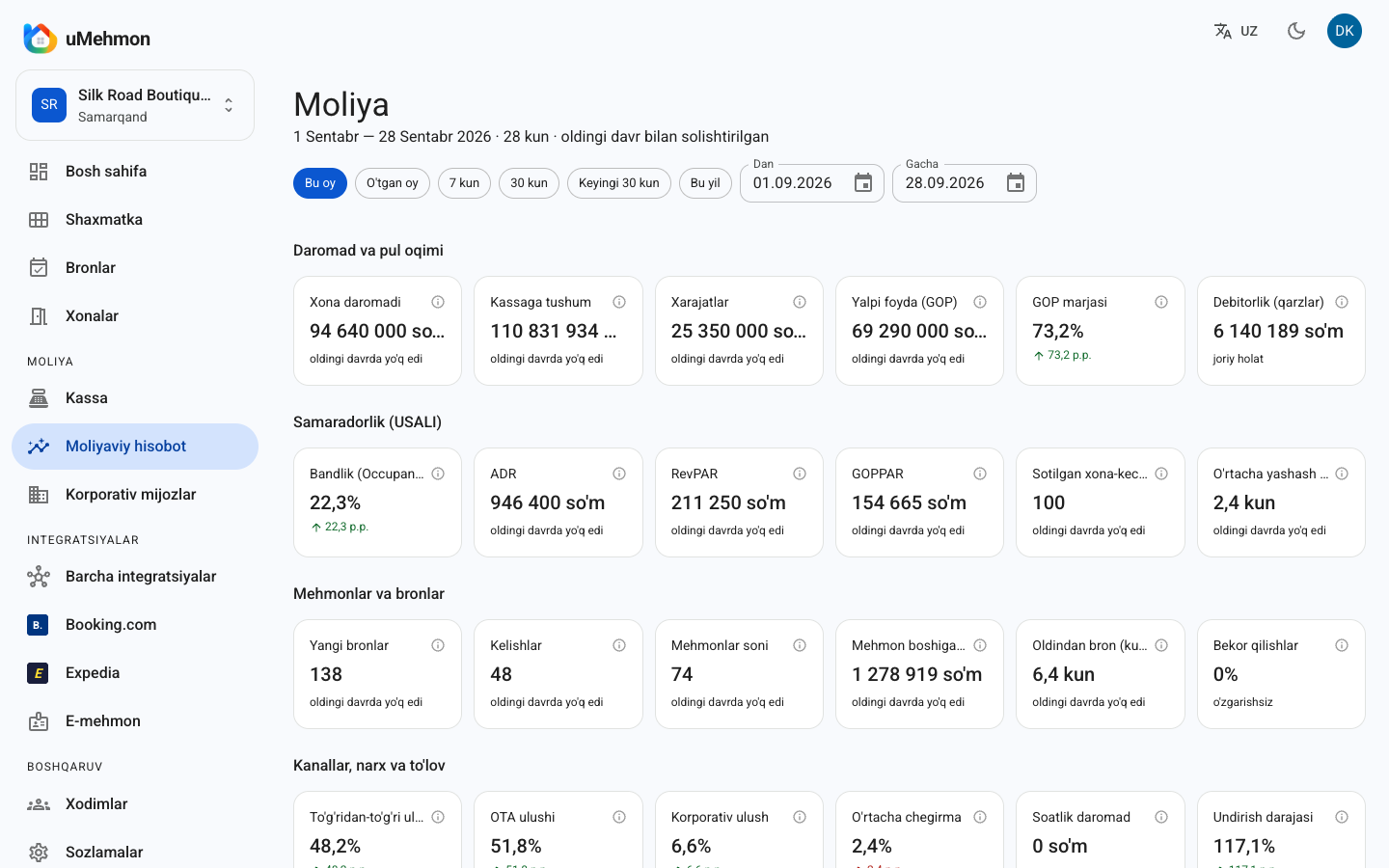
Short answer: AI for hotels is software that learns from your reservations, prices and guest interactions to forecast demand, recommend rates, answer routine questions and turn reports into clear actions. It works only when the underlying data is complete and consistent. uMehmon does not have AI features yet — they are in development — but it already gives hotels the structured PMS, channel and financial data that any serious hotel AI needs.
This page explains where artificial intelligence genuinely helps hotels, where it does not, how to evaluate AI tools, and what you can do with uMehmon today to be ready.
What does "AI for hotels" actually mean?
"AI" is used loosely in marketing, so it helps to split it into concrete categories:
- Predictive models estimate future occupancy, pickup and cancellations based on history and seasonality.
- Recommendation engines suggest a price, an upsell or a room assignment.
- Language models understand and generate text: answering guest messages, summarising reviews, drafting emails, explaining reports in plain language.
- Anomaly detection spots unusual patterns: a sudden spike in cancellations, cash discrepancies or prices entered far outside normal ranges.
- Optimisation solves scheduling problems such as housekeeping routes or room assignment to minimise gaps.
All of these share one requirement: they learn from data. If reservations live partly in a notebook, partly in Excel and partly in an OTA extranet, no model can see the full picture.
Where AI helps hotels most
Revenue management and pricing
AI-assisted revenue management looks at booking pace, lead time, day of week, events and past performance to suggest a price per date and room type. The goal is to raise ADR when demand is high and protect occupancy when it is low. Read more about the concept in What is dynamic pricing.
Demand and occupancy forecasting
A forecast tells you how many rooms you are likely to sell for each future night. It helps with staffing, purchasing and deciding when to open or close channels. Forecasts are especially useful for properties with strong seasonality, such as hotels in Samarkand, Bukhara or Khiva.
Guest communication
Language models can draft answers to frequent questions — check-in time, parking, airport transfer, breakfast — in several languages. Used carefully, this shortens response time on messengers and email, which directly affects conversion of direct bookings.
Review and feedback analysis
AI can group guest reviews by topic (cleanliness, staff, noise, Wi-Fi) and sentiment, so managers see recurring issues instead of reading hundreds of comments one by one.
Reporting assistants
Instead of scanning dashboards, a manager can ask a question like "why did RevPAR fall last month?" and receive an explanation that points to the drivers: lower occupancy, higher discounts or more cancellations.
Operations
Predicting check-out and arrival volume helps plan housekeeping. Anomaly detection in the cash desk and audit log can flag unusual voids or discounts for review.
AI use cases at a glance
| Use case | Input data | Output | Human role |
|---|---|---|---|
| Rate recommendations | Booking pace, ADR history, lead time, occupancy | Suggested price per date | Approves or adjusts the price |
| Occupancy forecast | Past reservations, cancellations, seasonality | Expected rooms sold per night | Plans staff and channels |
| Guest messaging assistant | FAQs, hotel policies, booking details | Draft reply | Checks and sends |
| Review analysis | Guest reviews and comments | Topics and sentiment summary | Decides on improvements |
| Reporting assistant | KPIs such as Occupancy, ADR, RevPAR, GOP | Plain-language explanation | Interprets and acts |
| Anomaly detection | Cash desk operations, audit log | Alerts on unusual activity | Investigates |
Comparison: manual, rule-based and AI-assisted management
| Aspect | Manual (paper, Excel) | Rule-based PMS (uMehmon today) | AI-assisted (uMehmon roadmap) |
|---|---|---|---|
| Pricing | Owner's intuition, changed rarely | Price ranges per room type, manager approval outside the range | Suggested prices per date based on forecast demand |
| Availability | Notebook or spreadsheet, high double-booking risk | Live chessboard synced with Booking.com and Expedia | Same, plus forecasts of pickup |
| Reporting | Manual calculations at month end | About 24 USALI-based KPIs with period comparison | Automatic explanations and recommendations |
| Control | Hard to trace who changed what | Immutable audit log of every action | Alerts on unusual patterns |
| Guest communication | Staff answer everything manually | Staff answer, data is in the booking and folio | Draft replies generated for staff review |
The important point: you cannot jump from column one to column three. AI-assisted management is built on top of a rule-based PMS with clean data.
What does AI need from your hotel?
- Complete history. Every booking, including walk-ins and phone reservations, with dates, room type, price, source and status.
- Consistent definitions. A cancellation should always be recorded as a cancellation, not deleted.
- Channel attribution. You need to know whether a booking came direct, from an OTA or from a corporate client.
- Financial data. Payments, costs and discounts, so AI can optimise profit rather than only occupancy.
- Time. Seasonal patterns only appear after enough months of data; the sooner you start recording, the sooner forecasting becomes useful.
A realistic AI adoption path
Hotels rarely go from paper to automated pricing in one step. A staged approach keeps risk low and lets the team build trust in the numbers.
| Stage | What you do | What you gain | Readiness signal |
|---|---|---|---|
| 1. Digitise | Move all bookings, rooms and payments into a cloud PMS | One source of truth, fewer double bookings | No more parallel notebooks or spreadsheets |
| 2. Standardise | Use consistent statuses, sources, price ranges and expense categories | Reliable KPIs every month | Reports match the cash desk without manual fixes |
| 3. Analyse | Review Occupancy, ADR, RevPAR, lead time and cancellations against previous periods | Data-driven decisions made by people | Managers explain changes using KPIs |
| 4. Assist | Add AI forecasts, explanations and draft recommendations | Faster analysis, earlier warnings | Recommendations are reviewed and mostly accepted |
| 5. Automate selectively | Let AI act within strict limits, for example prices inside a min–max range | Time savings on routine decisions | Clear guardrails and an audit trail for every change |
Most independent hotels in Uzbekistan are between stages 1 and 3. That is not a weakness: it is exactly where the groundwork for AI is laid.
Why the local context matters
Generic AI tools are usually trained on markets with different booking habits. In Uzbekistan, a large share of guests still book by phone or messenger, many corporate stays are paid by bank transfer, prices are often quoted in both UZS and USD, and foreign guests must be registered in E-mehmon. An AI assistant that ignores walk-ins, messenger bookings or currency differences will misread demand. That is why the data has to come from a PMS that already reflects how local hotels actually work.
Q&A: common questions from hotel owners
Question: Do I need a data scientist to use hotel AI? Answer: No. Modern AI features are built into software and should explain their suggestions in plain language. What you need is disciplined data entry.
Question: Can I simply use a public chatbot with my hotel's spreadsheet? Answer: It is risky. Guest passport data and payments are personal data; they should stay in a secure system with role-based access.
Question: Should AI change prices automatically? Answer: Most hotels start with recommendations that a manager approves. Full automation makes sense only after you trust the model and set clear minimum and maximum limits.
Question: What is the first AI use case worth trying? Answer: Usually reporting and forecasting, because they carry low risk: they inform decisions without acting on their own.
KPIs and formulas AI works with
AI tools do not invent new metrics; they optimise the standard ones. Knowing the formulas helps you judge any recommendation. uMehmon's hotel analytics calculates these today.
| KPI | Formula |
|---|---|
| Occupancy | Rooms sold ÷ Rooms available × 100% |
| ADR | Room revenue ÷ Rooms sold |
| RevPAR | Room revenue ÷ Rooms available (or ADR × Occupancy) |
| GOPPAR | Gross operating profit ÷ Rooms available |
| ALOS | Room-nights sold ÷ Number of bookings |
| Cancellation rate | Cancelled bookings ÷ All bookings × 100% |
Example (illustrative): a 30-room hotel over a 30-day month has 900 available room-nights. It sells 630, so Occupancy = 630 ÷ 900 = 70%. Room revenue is 378,000,000 UZS, so ADR = 378,000,000 ÷ 630 = 600,000 UZS and RevPAR = 378,000,000 ÷ 900 = 420,000 UZS.
Example (what a recommendation means): if a pricing tool suggests raising ADR to 650,000 UZS while occupancy falls to 65% (585 room-nights), RevPAR becomes 585 × 650,000 ÷ 900 = 422,500 UZS — slightly higher than before. If occupancy fell to 60% instead, RevPAR would be 390,000 UZS, lower than before. This is exactly the trade-off a manager should check before accepting any AI suggestion.
Pros and cons of AI in hotels
Pros
- Faster, data-driven pricing decisions instead of monthly guesswork.
- Earlier warning about low-demand periods and unusual cancellations.
- Less routine work for reception: draft answers and summaries.
- Clearer management reports for owners who are not finance specialists.
- Consistency: the same logic is applied every day, even when the manager is away.
Cons and limitations
- AI is only as good as the data; incomplete records lead to wrong suggestions.
- New properties lack the history needed for reliable forecasts.
- Local events, holidays and one-off situations are hard for models to anticipate.
- Automatic actions without human review can damage guest trust or revenue.
- Privacy and data protection require careful vendor selection.
- AI adds cost and complexity; it should solve a clear problem, not follow a trend.
How to choose an AI tool for your hotel
- Start with a problem, for example "prices are updated too rarely" or "we answer messages too slowly".
- Check the data source. The tool must read directly from your PMS and channel manager, not from manual uploads.
- Demand explanations. Every recommendation should show why: demand, pace, competitor or seasonality.
- Keep limits. Use minimum and maximum prices so no automated suggestion goes below your cost or above reason.
- Review access and privacy. Role-based access, logging of actions and no reuse of guest data.
- Measure results with the same KPIs before and after: ADR, RevPAR, occupancy and cancellation rate.
What uMehmon offers today — and what is coming
To be transparent: uMehmon does not include AI features yet. An AI assistant and AI-driven analytics are in development and on the roadmap, along with automated dynamic pricing. What you get today is the foundation that makes AI useful later:
- Chessboard (tape chart): every reservation, room move, extension and cancellation recorded in one place and updated live for all staff.
- Price ranges: minimum and maximum price per room type with manager approval outside the range — the same guardrails AI pricing will respect.
- Channel manager: two-way iCal sync with Booking.com and Expedia, Booking.com Connectivity API for certified accounts, overbooking alerts. Every booking keeps its source. See the channel manager.
- Analytics: around 24 USALI-based KPIs, including Occupancy, ADR, RevPAR, GOPPAR, ALOS, lead time, cancellation rate, direct/OTA/corporate share, with comparison to the previous period and daily charts.
- Cash desk and folio: payments in UZS and foreign currencies, cards, transfers, expense categories and voids with a reason — complete financial data for profit analysis.
- Audit log: who did what and when, old and new values, impossible to edit or delete, exportable to CSV.
- E-mehmon integration for automatic guest registration in Uzbekistan.
In other words, every month you work in uMehmon builds the history that future AI features will learn from. Learn more about the core system on the hotel PMS page or the hotel management system overview.
How to prepare your hotel for AI with uMehmon
- Register for the 14-day free trial with full access for up to 30 rooms.
- Put all reservations in one system — OTA, direct, walk-in and corporate.
- Connect channels so bookings arrive with their source automatically.
- Record every payment and expense in the cash desk.
- Review KPIs monthly and note the decisions you make and why.
- Activate AI modules when they are released and compare results with your baseline.
Conclusion
AI can make hotel pricing, forecasting and communication faster and more consistent, but it is not a shortcut around good operations. The hotels that benefit first will be those that already record every booking, price and payment in one reliable system. uMehmon gives you that system today, and AI features are on our roadmap to build on top of it.
Start a 14-day free trial — create your uMehmon account and start building the data foundation your hotel's AI will need.
How to prepare your hotel for AI with uMehmon
- 1
Start the free trial
Register at umehmon.uz/register and get 14 days of full access for up to 30 rooms.
- 2
Move all reservations into one system
Add rooms and room types, then record every booking, including walk-ins and phone bookings, on the uMehmon chessboard.
- 3
Connect your channels
Link Booking.com and Expedia via the channel manager so OTA bookings arrive with their source automatically.
- 4
Record payments and costs
Use the cash desk for every payment and expense category so revenue and GOP figures are complete.
- 5
Review KPIs every month
Use the analytics dashboard to track Occupancy, ADR, RevPAR, lead time and cancellation rate against the previous period.
- 6
Activate AI modules when released
When uMehmon AI features launch, they can work on the clean history you have already accumulated.
Frequently asked questions
AI for hotels means software that learns from booking, pricing and guest data to predict demand, suggest prices, answer guest questions or summarise reports. It supports staff decisions rather than replacing the hotel team.
No, not yet. AI features in uMehmon are in development and on the roadmap. Today uMehmon provides the clean, structured data AI depends on: reservations on the chessboard, price ranges, around 24 USALI-based KPIs, channel data from Booking.com and Expedia, and a tamper-proof audit log.
Yes, but the value depends on data quality more than on hotel size. A small property with consistent reservations, prices and payments recorded in a PMS is a better candidate for AI than a large hotel that still works in Excel.
No. AI is good at repetitive analysis and first-line answers, but guest hospitality, negotiation with corporate clients and final pricing decisions remain human responsibilities. The realistic goal is to save staff time and reduce mistakes.
At minimum: complete reservation history with dates, room types, prices, channels and cancellations, plus payments and costs. The data should be in one system and recorded consistently, otherwise AI will learn from errors.
No. A price range sets a minimum and maximum that staff must respect. AI dynamic pricing suggests a specific price for each date based on forecasted demand. uMehmon has price ranges today; automated dynamic pricing is on the roadmap.
Only if the provider processes data securely, limits access by role and does not reuse personal data for unrelated purposes. Passport and payment data should never be pasted into public chatbots.
Start using uMehmon now with the 14-day free trial. The history you build in the PMS, cash desk and channel manager is exactly what future AI features will analyse, and new modules will be announced to existing customers first.
Try uMehmon free for 14 days
Tape chart, reservations, cash desk, E-mehmon and Booking.com — in one platform. No credit card required.
Start free trial