Apart-Hotel PMS: Run Serviced Apartments, Long Stays and Corporate Accounts
Short answer: an apart-hotel PMS is a property management system that treats every apartment as its own unit and handles long stays, frequent extensions and company billing. In uMehmon each unit has its own row on the tape chart, stays are extended in a couple of clicks, companies get discounts and receivables tracking, and guests are registered in Uzbekistan's E-mehmon system automatically. You can start a 14-day free trial today.
How is an apart-hotel different from a hotel?
Apart-hotels, serviced apartments and guest houses sit between a hotel and a conventional rental. Guests get an apartment with a kitchen and living space rather than a room, yet still rely on a front desk, housekeeping and official registration.
From an operations point of view, the key differences are:
- Longer stays. Guests stay a week, a month or more rather than one or two nights.
- Extensions. A consultant whose project runs over, or a family waiting for renovations to finish, may extend several times.
- Corporate clients. Companies house employees and pay the bill themselves, often monthly against an invoice.
- Every unit is different. Apartments vary in size, fit-out and price; you can't lump them together as "standard rooms".
- Different housekeeping rhythm. Long stays get scheduled cleans rather than daily service, with a deep clean after departure.
A spreadsheet, or a system designed purely for short hotel stays, quickly gets tangled in these workflows. An apart-hotel needs a proper hotel PMS — configured the right way.
What uMehmon gives an apart-hotel
Below are features that are live in the product today, mapped to apart-hotel scenarios.
Every apartment on its own tape-chart row
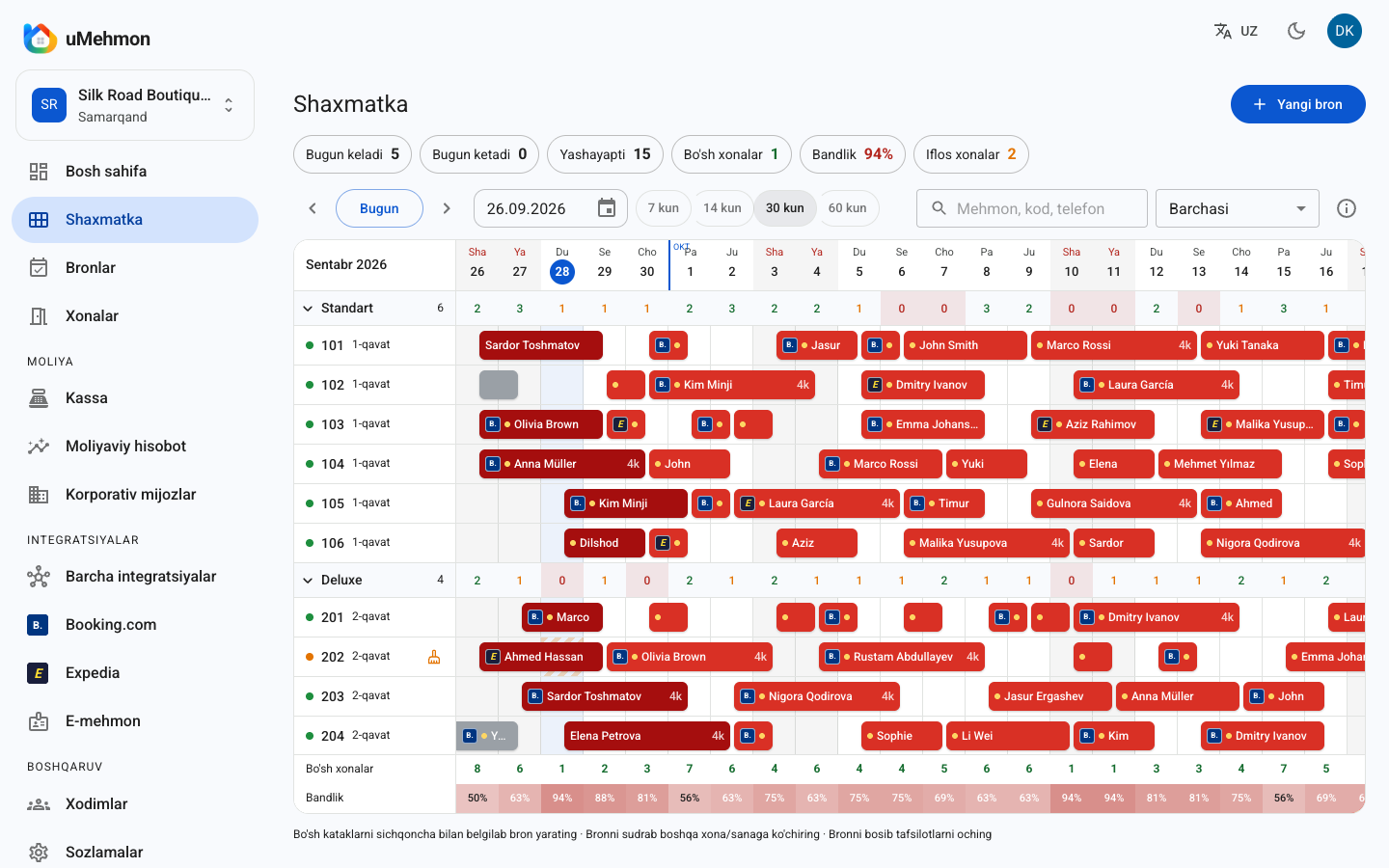
Each apartment, studio or guest-house room is set up as a separate unit. The tape chart offers 7, 14, 30 and 60-day views; for long stays the 30 and 60-day views are especially useful — at a glance you see which units are booked through month-end and which free up next week.
- Drag a booking to another unit or date
- Select empty cells to create a booking
- Live updates, so several staff can work at once
- A daily summary: occupied, vacant, arrivals, departures and occupancy percentage
- An "unassigned bookings" row for reservations without a unit, with an overbooking warning
Extend, shorten and move stays
The most common action with long-stay guests is the extension. In uMehmon you do it from inside the booking: set the new departure date, the tape chart updates, and the extra nights are added to the folio. If the unit is already sold to someone else for those dates, you see the clash immediately and can move the guest to another unit, recording the reason.
The reverse works too. On an early departure the remaining nights are released and the unit returns to sale once cleaned. Late check-out can be sold as a paid extra.
Corporate accounts and receivables
For apart-hotels, companies are a steady revenue base. In uMehmon each company gets a profile with:
- A discount percentage (corporate rate)
- A billing rule: "company pays" or "guest pays"
- Accounts receivable — the company's unpaid balance
- Invoices on your letterhead with logo, company details, tax ID, bank details, amount in words and numbering such as INV-2026-00001, printed or exported to PDF
The financial analytics show corporate revenue share and collection rate separately, so you know how much income comes from companies and how much is still outstanding.
Per-unit housekeeping
Every unit is clean, dirty or inspected. On check-out it turns dirty automatically and can't be assigned for today until it's cleaned. During a long stay you can update the status manually after a mid-stay clean. Units under maintenance come out of inventory — a common situation in apartments, whether it's plumbing, furniture or appliances.
E-mehmon: long-stay guests are covered too
However long a guest stays, they must be registered in E-mehmon. uMehmon does this automatically at check-in and asks at check-out whether to deregister the guest as well. Passport data can be pulled from the Ministry of Internal Affairs database, foreign guests have visa and border-crossing fields, failed submissions retry automatically, registration numbers can be entered by hand, and everything is logged in the E-mehmon journal.
Cash desk: prepayments and instalments
Long-stay guests often pay upfront or in instalments. The folio shows every payment and the running balance. The cash desk accepts UZS and foreign currency cash (USD, EUR, RUB), Uzcard, Humo, Visa, Mastercard, POS terminals, bank transfers and online payments. Central Bank exchange rates update with one click. Transactions can't be deleted — only voided with a reason.
Hourly bookings and walk-ins
Some guest houses and apartments also sell day-use stays. Hourly bookings longer than 8 hours are charged at the nightly rate. Walk-ins — guests who arrive without a reservation — are checked in within a few clicks.
Distribution channels
The Pro and Business plans include a channel manager: two-way iCal sync with Booking.com (live now), the Connectivity API with a certified account, and Expedia via iCal. Incoming bookings are placed into a free unit automatically, and your availability is pushed back to the OTA to prevent double bookings. Airbnb, Agoda and other channels are on the roadmap — see Airbnb integration for the current status.
A typical week in an apart-hotel running uMehmon
- Monday. A partner company books two engineers for two weeks. The manager creates the booking from the company profile; the discount applies automatically and the billing rule is "company pays".
- Check-in. The receptionist pulls passport data from the government database and the guests are registered in E-mehmon automatically.
- Wednesday. A three-night Booking.com reservation arrives and lands in a free studio; it shows up red on the tape chart and every screen gets a notification.
- Friday. A mid-stay clean is done in a long-stay unit and its status is updated.
- The following week. The company's project runs over, so the manager extends the stay by another week and the folio updates itself.
- Departure day. The guests leave, the units turn dirty, and the system offers to deregister them from E-mehmon. An invoice prints on letterhead for the company and the amount moves into receivables.
- Month-end. The owner compares occupancy, ALOS, corporate share and collection rate against the previous month.
At no point is data typed twice: the booking, E-mehmon record, folio, invoice and report are different views of the same record.
Team and roles
Apart-hotels usually run lean: one manager, one or two front-desk staff and housekeeping. uMehmon has five roles — Superadmin, Director, Manager, Finance (cashier) and Front Desk. The activity log keeps a tamper-proof record of who changed a booking, who applied a discount and who voided a cash transaction, with old and new values, so oversight doesn't depend on the owner being on site.
Comparison: ways to run an apart-hotel
| Criterion | Spreadsheet / logbook | OTA extranet only | Generic hotel software | uMehmon |
|---|---|---|---|---|
| Each apartment tracked separately | Manual | In the OTA calendar | Often by room type only | Yes, own tape-chart row |
| Stay extensions | Rewrite rows | Limited via OTA | Yes | From the booking, folio updates |
| Corporate billing and receivables | Separate sheet | No | Varies | Company profile, invoice, balances |
| E-mehmon | Manual on a separate portal | No | Rarely | Automatic at check-in and check-out |
| Housekeeping status | Verbal | No | Yes | Clean/dirty/inspected, automatic |
| Multi-currency cash desk | Manual | No | Varies | UZS, USD, EUR, RUB, cards |
| Audit trail | No | No | Rarely | Immutable activity log |
Apart-hotel metrics: formulas and worked examples
With long stays, some metrics matter more than in a classic hotel. A high ALOS, for example, spreads cleaning and check-in costs across more nights.
| Metric | Formula | What it means for an apart-hotel |
|---|---|---|
| Occupancy | Unit-nights sold ÷ Unit-nights available × 100% | How full your apartments are |
| ADR | Revenue ÷ Unit-nights sold | Average rate per night |
| RevPAR | Revenue ÷ Unit-nights available | How hard each unit works |
| ALOS | Unit-nights ÷ Number of bookings | Average nights per stay |
| Corporate share | Corporate revenue ÷ Total revenue × 100% | Dependence on company clients |
| Collection rate | Amount collected ÷ Amount billed × 100% | How quickly balances are paid |
Example: a 12-unit apart-hotel sells 288 unit-nights in a 30-day month. Available unit-nights = 12 × 30 = 360. Occupancy = 288 ÷ 360 = 80%.
Example: that month had 24 bookings. ALOS = 288 ÷ 24 = 12 nights. If each departure needs one deep clean, that's about 24 cleans for the month — with an ALOS of 3 nights, the same occupancy would require 96.
Example: companies were billed 20,000,000 UZS in the month and paid 15,000,000 UZS. Collection rate = 75%, with 5,000,000 UZS still in receivables.
uMehmon calculates these automatically in hotel analytics and compares them with the previous period.
Questions and answers
Question: How do we price a monthly stay? Answer: Bookings are charged per night, so a monthly agreement is set up as a nightly rate within the rate range or through a corporate discount. Anything outside the range needs manager approval.
Question: What if one company takes five apartments at once? Answer: A group booking bundles several units under one name: check them all in, out or cancel them together, with billing tied to the company profile.
Question: The owner lives in another city — can they stay in control? Answer: Yes. The system runs in the browser, so occupancy, cash and reports are available on a phone, and the activity log shows every change.
Question: Can some units sell nightly and others long-term? Answer: Yes. All units share one tape chart, short and long stays sit side by side, and analytics show overall ALOS and occupancy.
Pros and cons
Pros
- Every apartment is its own unit with its own occupancy and revenue
- Extend, shorten or move a stay in a couple of clicks
- Company profiles, discounts, receivables and invoices on letterhead
- Automatic E-mehmon registration, including for long-stay guests
- Housekeeping status drives availability: a dirty unit can't be sold
- Cloud-based: the owner can oversee the property from anywhere
- Several buildings or properties in one account
Cons and limitations
- No Airbnb integration yet (on the roadmap) — a real gap for properties that sell heavily on Airbnb
- No lease-contract or utility-billing module — the system works on a per-night accommodation model
- No website booking engine yet
- No Payme/Click online payments or fiscal receipt integration yet
- No native mobile app (the web app works on phones)
- No English interface yet — Uzbek and Russian only
- The Start plan excludes the channel manager
Which plan fits?
| Property | Plan | Price per month | Why |
|---|---|---|---|
| Up to 10 units, direct and corporate sales | Start | 290,000 UZS | 10 units, 2 users, no channels |
| 11–40 units or Booking.com sales | Pro | 590,000 UZS | 40 units, 10 users, channel manager |
| Large complex or several buildings | Business | 990,000 UZS | 300 units, 50 users |
Example: a 12-unit apart-hotel on Pro pays 590,000 ÷ 12 ≈ 40,800 UZS per unit per month. Compare that with your own ADR to see what fraction of a single night in a single unit it represents.
Guest houses and small properties
Guest houses are often family-run with few staff. The main benefit of a system here is order: who arrives when, who has paid, which room is clean, and whether everyone is registered in E-mehmon. The Start plan covers up to 10 rooms and 2 users. If your guest house sells individual beds, look at hostel mode on the hostel management software page.
For general selection criteria, see our hotel management system page.
Global platforms vs a locally built system
Global apartment and short-term rental platforms usually excel at channel reach. In Uzbekistan, though, local requirements — E-mehmon, a UZS cash desk, Uzcard and Humo, Central Bank rates — often mean extra configuration or manual workarounds. uMehmon covers local operations first and adds international channels step by step. Ask yourself how much of your business comes from OTAs versus companies and direct guests. If corporate and direct sales are significant, a system that knows local requirements tends to pay off.
Guest and company data security
Apart-hotels hold guest passports, company details and payment histories. In uMehmon each property's data is isolated, integration keys are stored encrypted, and access is governed by sessions and roles. Because data lives in the cloud rather than on a receptionist's PC, nothing is lost or walks out the door when staff change, and their full action history stays in the log.
Migration tips
- Give every apartment an unambiguous name (for example "A-12" for building and flat) to avoid confusion on the tape chart.
- Group apartments by size and bedroom count, and set a rate range per type.
- Enter all partner companies upfront so new corporate guests land on the right account immediately.
- Enter in-house guests with their real check-in dates so ALOS and occupancy are calculated correctly.
- Agree a cleaning schedule with the team and build the habit of updating statuses daily.
Conclusion
Apart-hotels, serviced apartments and guest houses run to a different rhythm than a classic hotel: long stays, frequent extensions, company billing and units that are each a little different. uMehmon brings these workflows together in one system — every unit on the tape chart, extensions from the booking, corporate billing and receivables, automatic E-mehmon registration and a controlled cash desk. Some features, such as Airbnb and a booking engine, are still on the roadmap, and we say so openly.
Try it on your own apartments: start a 14-day free trial — sign up and run up to 30 units with every feature unlocked.
How to set up an apart-hotel in uMehmon
- 1
Create your account
Sign up at umehmon.uz/register and start the 14-day free trial.
- 2
Define apartment types
Add types such as studio, one-bedroom and two-bedroom with base rates and a rate range.
- 3
Add every unit
Enter each apartment under its own number or name so it gets its own row on the tape chart.
- 4
Set up corporate accounts
Create profiles for partner companies with their discount and who pays for the stay.
- 5
Connect E-mehmon, the cash desk and channels
Configure the E-mehmon integration, payment methods and, on Pro or Business, Booking.com iCal sync.
- 6
Load current guests
Enter in-house guests and upcoming bookings on the tape chart and set each unit's housekeeping status.
Frequently asked questions
The core workflow is the same: reservations, check-in, payments and housekeeping. The difference is that apart-hotel guests stay longer, extend more often and are frequently billed to a company. uMehmon covers these with stay extensions, company profiles and accounts-receivable tracking.
Yes. Every apartment or studio is its own row on the tape chart with its own type, rate and housekeeping status, so occupancy and revenue are visible per unit.
Guests staying at accommodation properties in Uzbekistan must be registered in E-mehmon regardless of stay length. uMehmon registers them automatically at check-in and offers to deregister them at check-out, and the registration stays tied to the booking when the stay is extended.
Create a company profile with a discount percentage and a billing rule: company pays or guest pays. The company's outstanding balance shows up in accounts receivable, and invoices print on your letterhead.
Not yet — Airbnb is on the roadmap. Today the Pro and Business plans connect to Booking.com (iCal, plus the Connectivity API with a certified account) and Expedia (iCal).
Each unit is clean, dirty or inspected. During a long stay you update the status after a mid-stay clean; on check-out the unit turns dirty automatically and cannot be sold for today until it is cleaned.
Up to 10 units with no OTA sales: Start at 290,000 UZS per month. More than 10 units or Booking.com sales: Pro at 590,000 UZS for up to 40 units. Large complexes: Business at 990,000 UZS for up to 300 units.
Yes. One account can hold several properties, each with its own units, cash desk and reports, and the owner can switch between them.
Try uMehmon free for 14 days
Tape chart, reservations, cash desk, E-mehmon and Booking.com — in one platform. No credit card required.
Start free trial